Overview
A brand-new ProBase account starts empty — no customers, no jobs, nothing on the calendar — which makes it hard to picture how the app looks once your business is running in it. The demo account solves that. It’s a complete, ready-made ProBase business you can click around in: real-looking customers, jobs on the calendar, invoices, quotes, and completed checklists, all seeded for your line of work. Nothing you tap in the demo touches your own account.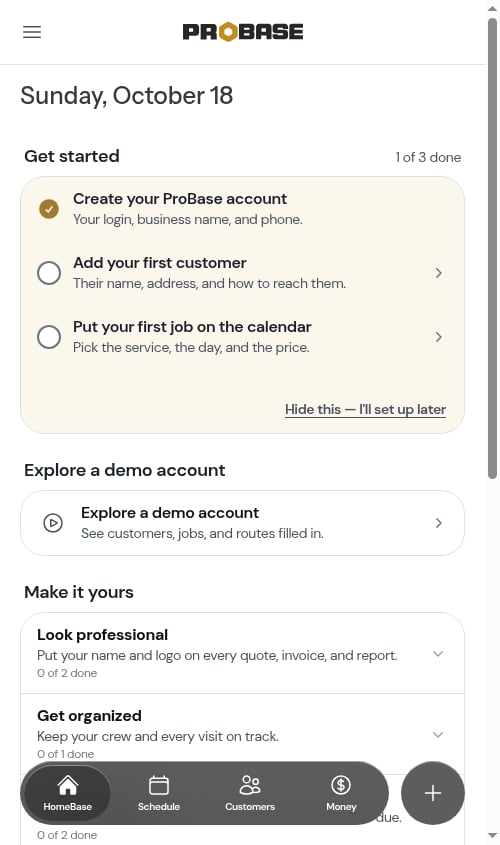
The demo is being rolled out gradually. If you don’t see the row or the menu item described below, it isn’t switched on for your account yet. The demo is also offered to business owners and admins only — crew members and other roles don’t see these prompts.
Ways in
ProBase offers the demo in a few places — use whichever is closest to hand:- The Explore a demo account row on HomeBase — a brand-new account sees an Explore a demo account section just below the Get started checklist, with one row reading See customers, jobs, and routes filled in. This row is for getting your bearings: it leaves HomeBase once you add your first customer or schedule your first visit, and doesn’t come back. See HomeBase.
- The Tour a demo item in the navigation menu — at the very bottom, in the Help group below Support, marked with a small flask icon. It stays available no matter how big your customer book gets, so you can always drop into the demo to try something out.
- A Tour demo card on an empty screen — when your Customers list, Schedule, or Money page has nothing in it yet, a card appears there too. See Tour demo from an empty screen.
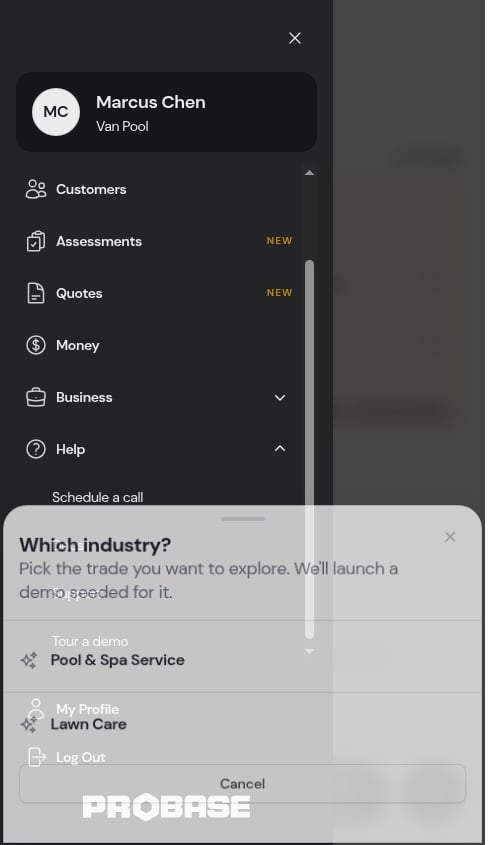
The wording differs a little between these spots — the HomeBase row says Explore a demo account, the navigation menu says Tour a demo, and the empty-screen cards say Tour demo. They all open the same demo.
Picking your trade
If more than one of the trades you told ProBase about during onboarding has its own sample account, ProBase first asks Which industry? — Pick the trade you want to explore. We’ll launch a demo seeded for it. Tap the trade you want and ProBase opens a demo built for it, or tap Cancel to stay where you are.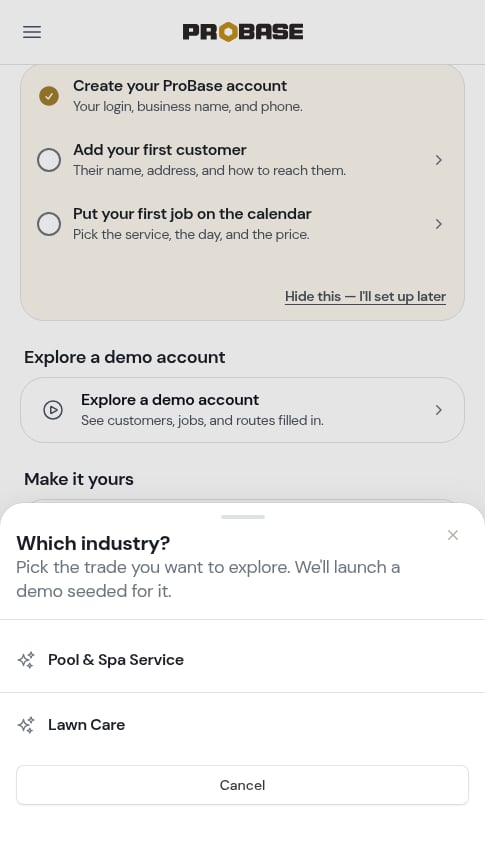
Because Handyman work spans so many kinds of small jobs, its sample account doubles as the general home-services demo — so a handyman business and a business whose trade has no sample account of its own end up looking around the same sample company. The only difference is the label: a declared handyman trade shows up as Handyman in the picker, while everything else is offered as Home services.
- Explore a demo account on HomeBase
- Tour a demo in the navigation menu
From HomeBase
Tapping Explore a demo account on HomeBase brings the Which industry? sheet up from the bottom of the screen.From the navigation menu
Tour a demo in the Help group works the same way — tap it and the trade picker opens over the menu.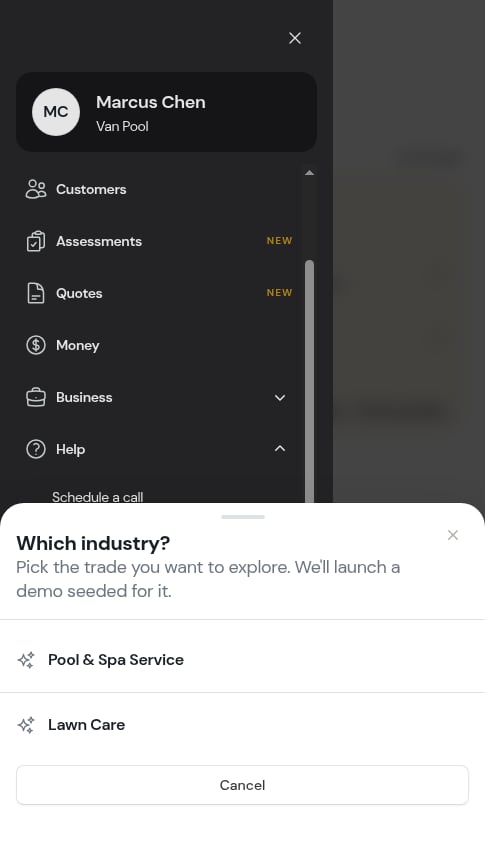
The empty-screen Tour demo cards are the one exception: they never ask, because they’re built to be a single tap onto the screen you were already looking at. If you do one trade they open that trade’s demo; if you do more than one, ProBase picks one for you.
Trying a different trade
You aren’t locked into the first demo you open. Tap Return to my account in the demo’s banner, then open the demo again from the HomeBase row or the menu item and pick the other trade. You can hop between trades as often as you like.1
Open the demo
Tap Explore a demo account on HomeBase or Tour a demo in the Help group of the navigation menu.
2
Choose a trade (only if you do more than one)
Tap the trade you want to look at, or Cancel to stay where you are.
3
Wait a moment while the demo opens
If you picked a trade, it swaps to a spinner reading Opening demo…; if you tapped the HomeBase row directly, the row dims while ProBase hands you over to the sandbox. It’s a full page change, so give it a couple of seconds — there’s no need to tap again.
4
Look around
The demo opens as a full ProBase account. Browse the schedule, open a customer, look at an invoice — nothing is off limits.
5
Come back with the banner
An orange bar sits at the top of every demo screen. Tap Return to my account to go back to your real ProBase.
Tour demo from an empty screen
Before you’ve added your own work, the screens that would normally be full of it offer the demo right where you are — on Customers and Schedule it sits under the button that adds the real thing, separated by a small or: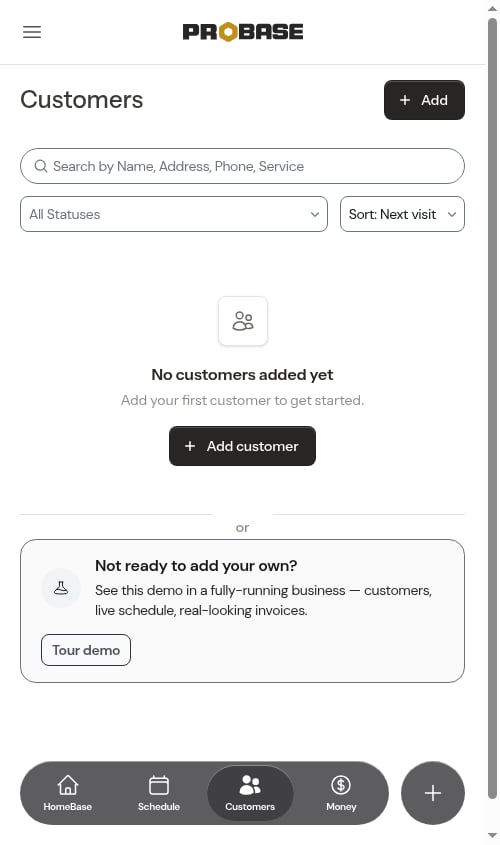
Tapping Tour demo drops you straight onto that part of the demo, so you land looking at exactly the screen you were curious about.
These cards only show on a genuinely empty screen. Searching or filtering your way to “no results” doesn’t count — the card stays away once you have real work of your own. Crew members don’t see it on the Schedule either; their empty schedule points them at their crew’s work instead.
What’s inside the demo
Each demo account is a busy business already in full swing, so you can see what every part of ProBase looks like with real work flowing through it:- A staffed team — an owner, a manager, and crew members, split across two crews with their own start and end locations
- About 30 customers — spanning every status: active, recently added, inactive, leads, and archived, each with properties, service history, and notes
- Inbound leads — the contact form is switched on with its public link live, and a couple of leads have already come in through it
- A priced service catalog — service offerings for that trade, each with the Most pros charge … pricing guidance under its price so you can see how the pricing hints read, plus add-on charges on visits, and checklists attached and filled in on completed visits — including before-and-after photos on a few of them
- A filled-in field log — each customer’s most recent completed visit carries its own service records, so a finished job’s detail page and the property’s Service Records page show real work instead of an empty section. What’s recorded matches the trade: a pool visit logs what the tech observed plus pH, chlorine, and alkalinity readings and the chlorine and acid applied; a lawn visit logs the mow-and-edge notes plus the fertilizer put down; a handyman visit logs the work done plus the material used
- A live calendar — a month of completed history behind you, overdue visits, jobs with no crew yet, work booked for today, and a year of recurring visits projected forward
- The full sales pipeline — assessments booked, quotes sent and waiting on an answer, and quotes that turned into scheduled jobs, including a quote still sitting in draft
- One customer who has been through everything — a sample customer deliberately built to carry every state a record can be in: an assessment in each stage (draft, sent, accepted, declined, and one that was cancelled), a job that’s running, one that’s finished, and one that was cancelled, and visits that were completed, rescheduled, skipped, and cancelled alongside one still booked. It’s the fastest way to see what each status badge looks like without having to work a job through its whole life first
- Real money movement — invoices in every state, payments taken by card, Venmo, and cash, tips, and customers carrying a past-due balance
- A customer whose jobs have actually been worked — one sample customer carries two jobs taken all the way through the visit page: a visit running on the clock right now, another paused, and a run of finished visits behind them showing what each state looks like afterwards. Among the finished ones: a visit that was paused partway through (so What happened reads two working windows), one with before-and-after photos on both photo checklists, one whose service report went out by text with the invoice riding along and came back rated five stars with a comment, one shared by Copy link and rated four stars with no comment, one whose report hasn’t been sent (so its checklists can still be reopened and edited), one that was reopened and edited after completion, a cancelled visit whose charges were moved to the next one, and a rescheduled visit with its Moved to marker. Her property also has a saved On my way message, so you can see one beside the default other properties use
- Customer reviews on completed work — stars in your updates feed, on the visit’s rating card, and on the customer’s portal home
- A working route map — the demo’s day view map plots the sample crews’ stops and draws the real driving path between them, so you can see what a full day of work looks like on the map, and route optimization runs there too
Finding your way back
The demo looks and behaves exactly like your own ProBase, so an orange bar with a small flask icon stays pinned to the top of every screen while you’re in it:🧪 You are currently viewing a demo — experiment here without making changes to your own account. Return to my account →On a phone the same bar shortens to Viewing a demo, to fit the narrower screen — the Return to my account link is still on the right. That bar can’t be dismissed, so you always know which account you’re looking at. Tap Return to my account to go back to your real ProBase whenever you’re done — the link shows a spinner reading Leaving demo… while the switch happens, so one tap is enough. There’s no separate login for the demo — you always enter it from your own account. If your demo session ends (or you open a demo link without going through ProBase first), you’re sent straight back to your real ProBase rather than to a demo sign-in screen. If the ProBase team sends you a link to the demo by email, opening it works the same way: it drops you into the sandbox, asking you to sign in to your own ProBase first if you aren’t already.
Don’t bookmark the demo’s web address itself. Each trip into the demo uses a fresh, short-lived handoff, so a saved demo address goes stale within a few minutes and shows the “temporarily unavailable” page below. Bookmark your own ProBase instead and enter the demo from the HomeBase row or the menu each time.
If the demo doesn’t open
Occasionally the demo can’t let you in — most often because the nightly rebuild is still finishing, or because you opened an old demo address instead of entering from your own ProBase. Rather than an error page, you get a plain message:The demo is temporarily unavailable We couldn’t open the demo right now. Please try again in a few minutes.A Back to ProBase button takes you straight back to your own account. Nothing is wrong with your account when this happens, and there’s nothing to fix on your end — wait a couple of minutes and open the demo again from HomeBase or the navigation menu. If it still won’t open after a few tries, contact support.
What’s different in the demo
The demo is deliberately sealed off so nothing you do there reaches the real world:- Nobody gets contacted. ProBase doesn’t send any email from the demo, and the automated text-message notifications are switched off there, so a sample customer never receives an invoice, a quote, or a reminder.
- No real money moves. Live card payments are turned off, so the customer payment screens in the demo show the Venmo option instead of card entry — and because the tip prompt rides along with card payment, those screens don’t ask for a tip either. No charge, refund, or payout can happen from the demo. (The history still shows card payments and tips already taken — those are sample records, not live transactions.)
- Marketplace accounts can’t be linked. Tapping Connect on an Integrations card in the demo leads to a “page not found” instead of the marketplace sign-in, so no real LawnStarter, Lawn Love, or Home Gnome account can be linked or unlinked from the sandbox.
- The account itself can’t be deleted. The options to delete the business or the user account are hidden inside the demo, so the sample world stays available for the next visit.
- Your email address is locked. On My Profile inside the demo, the Email field is read-only and a line below it reads Your email address can’t be changed in the demo environment. That address is what ties the sample account back to your real ProBase, so changing it would break the link between the two. Everything else on the profile — your name, your photo, your password, your maps app preference — is still yours to edit, though like everything else in the demo those edits are wiped overnight.
- The prompts about your account step aside. Anything that belongs to your real ProBase is hidden while you’re inside the demo, so nothing points you back out of the sample world by accident. That means none of the demo invitations (you’re already in it) — no Explore a demo account row, Tour a demo menu item, or empty-screen card — no Schedule a call in the Help group, and no Talk to Us card on HomeBase, since those reach the ProBase team about your real account. They’re all waiting for you the moment you tap Return to my account.
- Everything resets overnight. The demo world is wiped and rebuilt from scratch every night (around 3am Central), so any mess you make disappears — and the next time you visit, it’s a fresh, tidy business again.
Next steps
- HomeBase — your own daily dashboard
- Your first customer — start building your real book
- Getting around ProBase — a full tour of the navigation